7 Foundational Picture Card Activities That Build Vocabulary Naturally
- The English Method
- 31 August 2025
Vocabulary development forms the cornerstone of early communication skills. Research consistently shows that children who develop rich vocabularies in their foundational years have stronger language skills throughout their academic journey1. Picture cards provide an ideal tool for this development, offering visual concrete representations that young minds can easily grasp and remember.
For toddlers at the foundational developmental stage, learning happens best through repetition, play, and multi-sensory engagement2. The activities shared below have been tested and refined through classroom experience, designed specifically to meet the developmental needs of early learners while keeping engagement high.
These activities work with any picture card collection, though they are particularly effective with real photography cards that provide clear, unambiguous visual representations. Studies demonstrate that children learning vocabulary from photographs show substantially superior ability to transfer that learning to real-world object identification. Where noted, activities can be adapted based on the child’s current developmental stage and interests.
Table of Contents
1. Silly Voice Picture Card Naming
This foundational activity builds the essential connection between visual images and spoken words whilst adding irresistible fun through voice variations that children adore.
Materials needed:
- Thematic picture cards
- Clear surface for displaying cards
- Your most dramatic voice!
The Activity:
- Show a picture card to the child, ensuring they can see it clearly
- Name the item using different voice variations: whisper, sing-song, high-pitched, deep and low, robot voice, or super fast
- Encourage the child to repeat the word using the same silly voice
- Try the same word in multiple voice styles – children love hearing ‘apple’ whispered, then shouted, then sung
- Hold up cards one by one, using different voices for each item
- If the child struggles with a word, make it extra silly – a squeaky ‘mouse’ or a deep, growly ‘elephant’
- Let the children take turns picking a card and choosing which voice to use
Why silly voices work: Voice variations create multiple memory pathways for each word, making vocabulary more memorable. The element of surprise and humour keeps children engaged far longer than standard naming activities. Different vocal patterns also support auditory processing development.
Voice variation ideas:
- Whisper voice (great for ‘mouse’ or ‘baby’)
- Giant voice (perfect for ‘elephant’ or ‘zebra’)
- Dramatic sing-song voice (children find this very amusing!)
- Robot voice (mechanical and rhythmic)
- Squeaky voice (children seem to love this!)
- Echo voice (repeat the word getting quieter each time)
Developmental Progression: Start with highly familiar objects (ball, apple, cat) before introducing less common vocabulary. For children just beginning to speak, focus on single-word responses with exaggerated voices. As language develops, encourage simple descriptions in silly voices like ‘red ball’ in a whisper or ‘big elephant’ in a giant voice.
2. Picture Card Grab!
This activity combines vocabulary practice with quick thinking and physical movement, perfect for active learners who need motion to stay engaged.
Materials needed:
- Multiple picture cards (these 50 Words Picture Cards provide plenty of variety)
- Space to spread cards on floor or table
The Activity:
- Spread several picture cards on the floor or table where all are visible
- Call out the name of an item shown on one of the cards
- The child must quickly find and grab the corresponding picture card
- Once they grab it, have them name the item again to reinforce the connection
- If they grab an incorrect card, provide gentle guidance and encouragement to try again
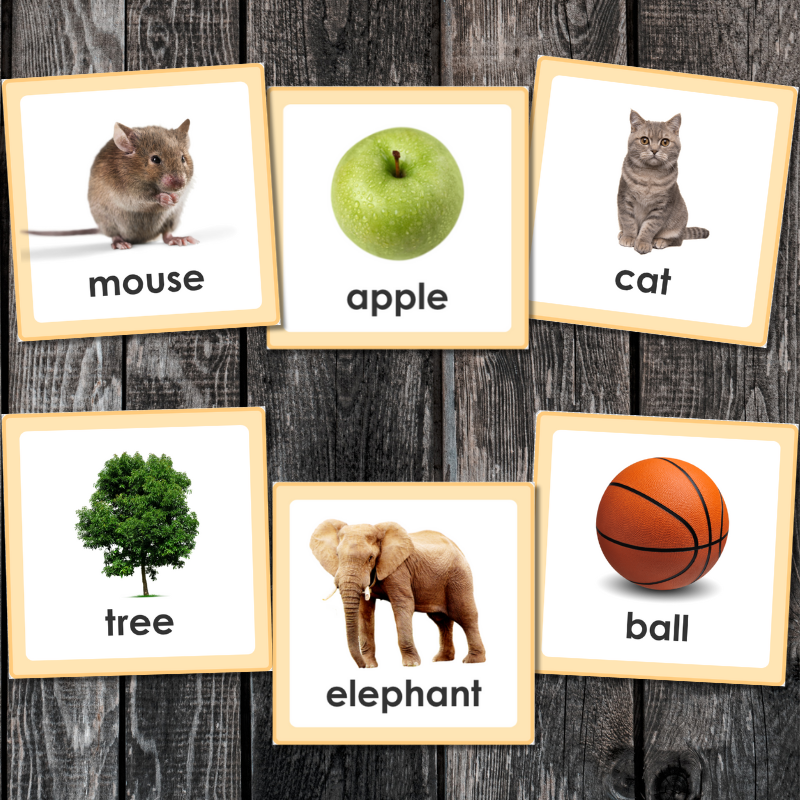
Developmental Progression: Begin with 3-4 cards for emerging learners, gradually increasing to 8-10 cards as recognition improves. For children still developing listening skills, point discretely towards the correct area whilst calling out the word.
Adaptation tip: For less mobile children, place cards within easy reach. The focus should be on recognition and naming rather than speed or physical challenge.
3. Peek-a-Boo!
The element of surprise and anticipation makes this controlled practice activity irresistible to toddlers whilst building memory and vocabulary skills simultaneously.
Materials needed:
- Thematic picture cards
The Activity:
- Hold a picture card behind your back, concealing it from the child
- Build anticipation by saying, ‘I have a picture. What is it?’
- Briefly reveal the picture card by bringing it forward whilst saying ‘Peek-a-boo!’, then quickly hide it again
- Repeat this peek-a-boo action 2-3 times, allowing the child to guess what they saw
- If the child guesses correctly, celebrate and fully reveal the card whilst naming it clearly
- If the child doesn’t know, give the answer and show the card fully: ‘It’s an apple!’
- Encourage the child to repeat the word after the big reveal
- Invite the child to take turns hiding and revealing cards
- Support their efforts by helping them create the same anticipation and excitement
Why this works: The peek-a-boo element triggers natural excitement and anticipation, making vocabulary learning feel like play rather than instruction. The brief glimpses also encourage focused attention and visual processing.
Extension ideas: After revealing the card, ask simple questions: ‘What colour is it?’ or ‘Do you like apples?’ This extends the vocabulary practice into conversation.
Our Story Corner vocabulary packs like Does a Kangaroo Have a Mother, Too? work particularly well for this activity – the familiar words from the beloved book add extra excitement when they ‘appear’ during peek-a-boo games.
4. Swat the Card!
This high-energy activity transforms vocabulary practice into an exciting game that appeals to kinaesthetic learners.
Materials needed:
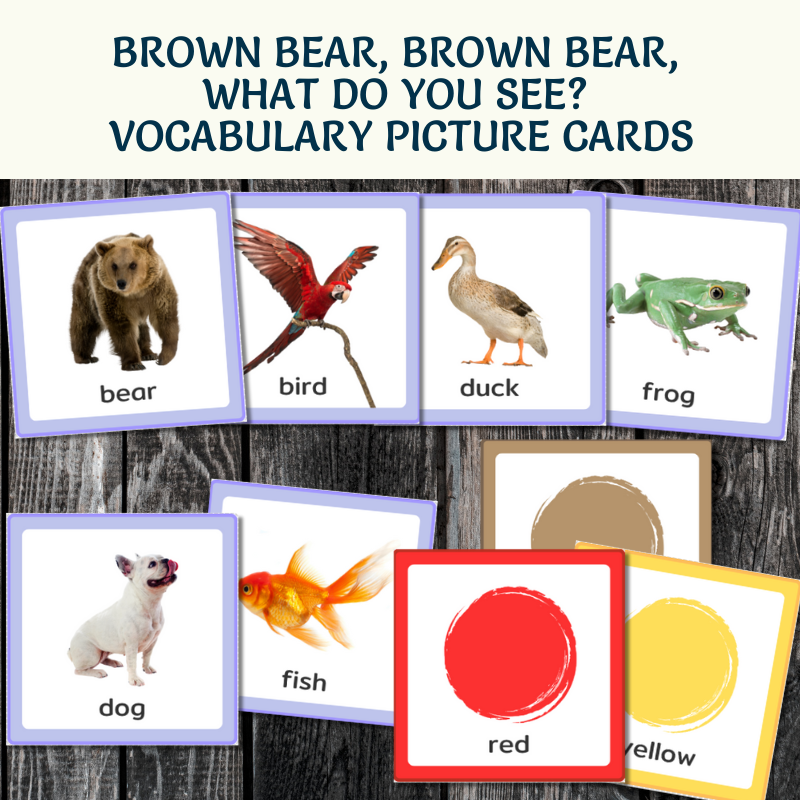
- Thematic picture cards (these Brown Bear Picture Cards are a popular choice)
- Fly swatter (clean, designated for play use)
- Wall space or large table surface
The Activity:
- Attach picture cards to the wall at the child’s height, or spread them on a table
- Call out the name of an item shown on one of the cards
- Demonstrate gently ‘swatting’ the corresponding card with the swatter
- Name the item again after swatting it
- Invite the child to take turns swatting cards as you call out different items
- Always emphasise gentle swatting to protect the cards
Progression tip: Start by swatting the card whilst the child watches, then gradually transfer the swatter to them as they understand the game concept.
5. Hide and Seek
This classic game concept applies beautifully to vocabulary learning, encouraging environmental awareness whilst practising word recognition.
Materials needed:
- Thematic picture cards
- Various hiding spots around your space
The Activity:
- Show the child a picture card and name the item clearly
- Explain that you’re going to hide the card somewhere in the room or garden
- Hide the card in a visible but not immediately obvious location
- Encourage the child to search for the hidden picture card
- When found, celebrate and have the child name the item again
- Take turns with the child choosing cards to hide
Educational benefits: This activity develops spatial awareness, following directions, and sustained attention whilst reinforcing vocabulary. The physical movement involved helps kinaesthetic learners retain new words more effectively.
I found that Story Corner vocabulary cards like Mr Brown Can Moo! Can You? are particularly engaging. When children get close to finding a hidden card, you can give sound clues on the cards to guide them, which children seem to love as it adds another auditory layer to the visual and physical elements of the game.
Adaptation suggestions: For younger children, make hiding spots more obvious and provide some obvious clues. As children develop, gradually make locations more challenging.
6. Treasure Hunt
Transform your learning space into an adventure zone where vocabulary discovery becomes an exciting quest.
Materials needed:
- Thematic picture cards
- Small containers (boxes, cups, bags)
- Various hiding locations
The Activity:
- Show the child a picture card and name the item together
- Explain that cards are hidden around the room inside ‘treasure containers’
- Place picture cards inside various containers and hide them throughout your space
- Give the child a container to collect their ‘treasures’
- As they find each container, they must open it and name the picture inside
- Celebrate each discovery with enthusiasm
- Encourage the child to help hide treasures for you to find
Why treasure hunts work: The quest element adds excitement and anticipation to vocabulary practice. Finding hidden objects triggers reward responses in the brain, making the associated words more memorable.
Progression ideas: Begin with obvious hiding spots, gradually making locations more challenging. Add simple maps or picture clues to guide the hunt as problem-solving skills develop.
7. Picture Card Fishing!
This activity combines fine motor skill development with vocabulary practice, perfect for children who enjoy hands-on activities.
Materials needed:
- Thematic picture cards with small magnets attached
- Fishing rod (stick with string and magnet attached)
- Container to hold the cards
The Activity:
- Attach small magnets to picture cards and place them in a container
- Demonstrate how to ‘fish’ for cards using the magnetic rod
- As the child catches each card, have them name the item shown
- If they need support, provide hints about the object’s colour, size, or use
- Take turns fishing and naming items
- Celebrate successful catches with enthusiasm
Setup tips: If creating magnetic fishing rods seems complex, simply scatter the cards on a table and let children use a big magnet to pick them up. The key is the action of ‘catching’ combined with naming.
Fine motor benefits: The precise movements required for fishing help develop hand-eye coordination whilst the vocabulary practice happens naturally through play.
Conclusion
These seven activities demonstrate how vocabulary learning can be embedded naturally into play experiences that toddlers find engaging and enjoyable. By incorporating movement, surprise, discovery, and hands-on interaction, we create learning opportunities that feel like games rather than lessons.
The key to success with any vocabulary activity lies in following the child’s interests and energy levels. Some days they might love the active swatting game, whilst other days the quiet peek-a-boo approach works better. Flexibility and responsiveness to their developmental needs will always yield the best results.
Foundational level materials are specifically designed to support this developmental approach to vocabulary building. The clear photography and carefully selected vocabulary items work seamlessly with activities like those shared above, creating comprehensive learning experiences that grow with the child.
Ready to enhance your vocabulary building toolkit?
Each component works together to create comprehensive, developmentally appropriate language experiences.
Explore foundational level resources here.
Join our newsletter to receive more practical activity ideas and early literacy tips delivered directly to your
References
- Hart, B., & Risley, T. R. (1995). Meaningful differences in the lives of American children. Paul H. Brookes Publishing.
- Shams, L., & Seitz, A. R. (2008). Benefits of multisensory learning. Trends in Cognitive Sciences, 12(11), 411-417.
- Ganea, P. A., Pickard, M. B., & DeLoache, J. S. (2008). Transfer between picture books and the real world by very young children. Journal of Cognition and Development, 9(1), 46-66.
© 2026 All Rights Reserved.