5 Multi-Sensory Letter Learning Activities - Foundational Level
- The English Method
- 23 May 2025
Building a strong foundation for literacy begins with letter recognition – the essential skill that connects written symbols to the sounds they represent. Research consistently shows that children learn most effectively when they engage multiple senses during the learning process, creating stronger neural pathways and improving retention1.
As we explored in our previous article ‘Wiring the Brain for Reading: The Multi-Sensory Approach’, engaging visual, auditory, and kinaesthetic pathways simultaneously creates robust learning experiences for young children. Today, I’m sharing five tried-and-tested multi-sensory activities that make letter learning engaging and effective for foundational level learners.
These activities have been tested and refined through years of classroom experience and are based on research showing that multi-sensory instruction significantly enhances letter recognition and phonological awareness in young learners2.
These activities work well with any alphabet cards or letter learning materials. Where noted, activities are enhanced by using cards that incorporate sound actions to reinforce the letter-sound connection through movement.
Table of Contents
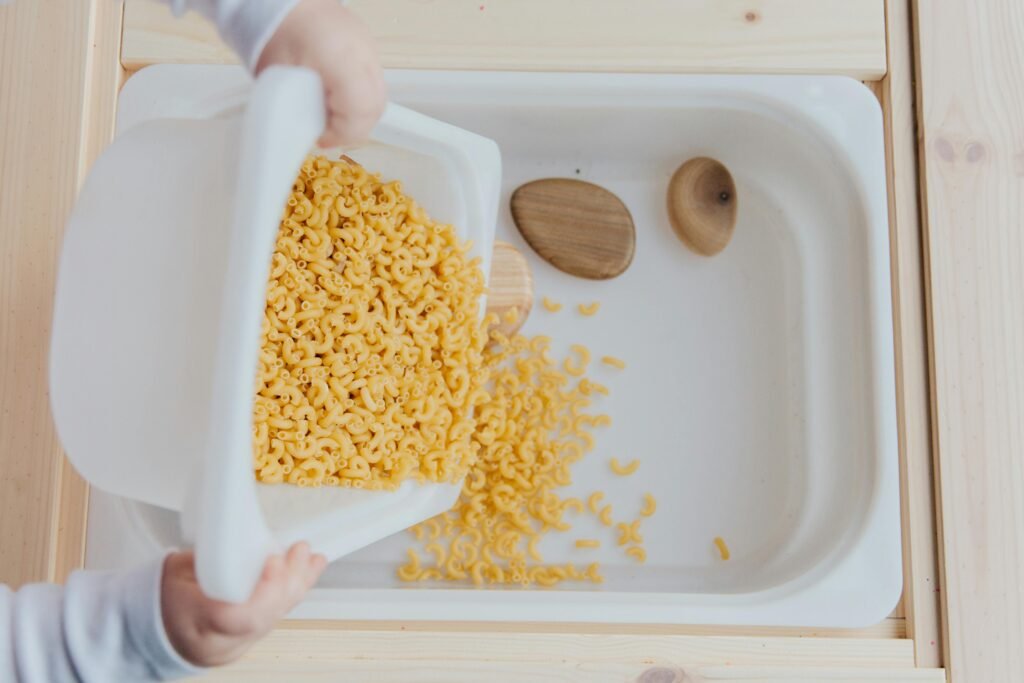
Alphabet Sensory Bin
Sensory bins combine tactile exploration with cognitive learning, making them perfect for young learners who learn through touch and discovery.
Materials needed:
- A shallow bin filled with rice, pasta, beans, polystyrene pieces, pistachio shells, etc.
- Alphabet cards with physical actions (our Phonics Sound Action Cards include specific kinaesthetic movements that make this activity highly effective)
- Small alphabet toys or magnetic letters (optional)
The Activity:
- Create the sensory bin
- Hide alphabet cards and/or toys within the bin
- Invite your child to find the hidden items and match them to the corresponding cards
- As they discover each match, encourage them to say the letter sound and perform the corresponding action
Progression tip: Start with toys only for beginning learners. As they progress, add magnetic letters for more advanced matching. Eventually, children will be able to match magnetic letters directly to cards without needing the toys.
Keep it fresh: Switch out the bin contents periodically – from pasta to polystyrene pieces to beans. This simple change makes the activity feel new and exciting, keeping children engaged for months. Different textures also provide varied sensory experiences that support learning.
For foundational learners, start with just 2-3 sounds. Our Phonics Sound Action Cards are grouped into 7 sound groups, making it easy to introduce sounds in the optimal linguistic sequence rather than alphabetical order.
What's Missing!
This simple yet effective memory activity helps children develop both visual discrimination and letter recognition skills.
Materials needed:
Alphabet cards (our Phonics Sound Action Cards feature clear lowercase letters on each card)
The Activity:
Lay out 3-5 cards on the table and name each letter together
Ask the child to close their eyes and count to 5
While their eyes are closed, remove one card
Ask them to open their eyes and identify which letter is missing
As children become more confident, increase the challenge by adding more cards or by asking them to not only name the missing letter but also to tell you its sound and a word that begins with it
Magic Letter Bag
The element of mystery makes this activity especially engaging for young learners, building anticipation while reinforcing letter recognition.
Materials needed:
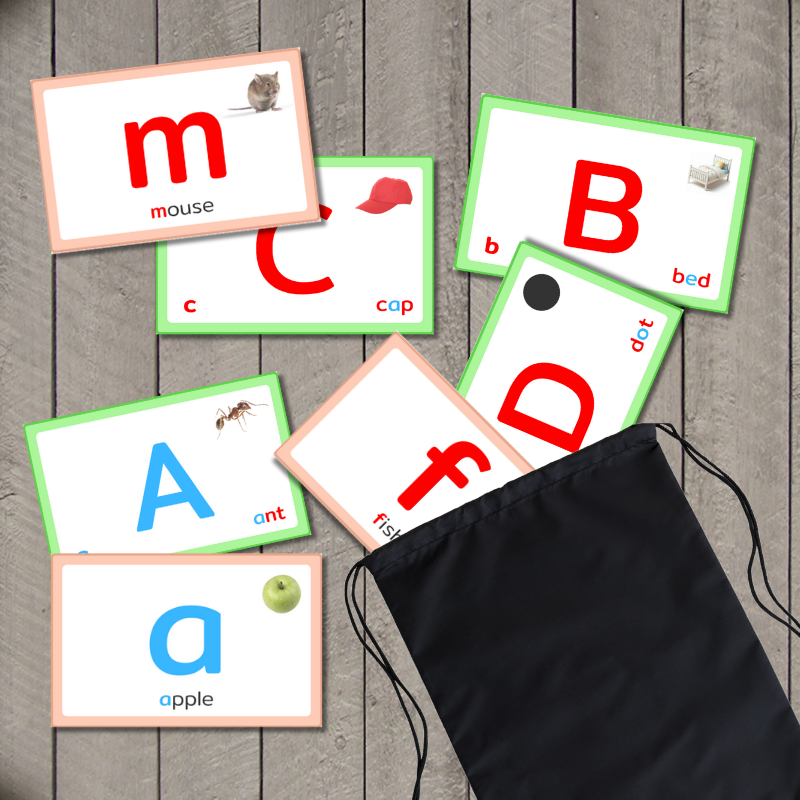
- A non-transparent bag
- Alphabet cards with sound actions (our Phonics Sound Action Cards feature systematic sound progression and corresponding movements)
The Activity:
- Place selected letter cards in the ‘magic’ bag
- Ask the child to say the magic words: ‘Abra cadabra fish and chips!’ (or whatever silly phrase they enjoy)
- Slowly pull out a card, showing just a small part of it as it ‘magically’ appears
- Encourage your child to guess which letter is peeking through
- Once revealed, have them say the letter sound and perform the corresponding action
This activity works exceptionally well with our Phonics Sound Action Cards, as each card features not only the letter but also a specific movement that reinforces proper sound formation through kinaesthetic learning. Research demonstrates that incorporating physical movement into letter learning significantly improves letter recognition and retention in young children3.
Trucks and Alphabet Rocks
This activity combines outdoor exploration with letter matching, perfect for active learners who need movement to stay engaged.
Materials needed:
- Small smooth pebbles
- Permanent marker
- Small toy trucks or cars
- Alphabet cards showing both uppercase and lowercase letters (our Alphabet Practice Cards feature clear uppercase-lowercase correspondence with Montessori-inspired colour-coding)
The Activity:
- Take a short walk outside with your child to collect smooth pebbles
- Write uppercase letters on some pebbles and lowercase letters on others
- Place the uppercase pebbles in various locations around the room
- Put one lowercase letter pebble in each toy truck
- Invite your child to ‘drive’ each truck to find its matching uppercase letter
This activity reinforces the crucial connection between uppercase and lowercase letters. Our Alphabet Practice Cards are specifically designed to support this learning, with each card clearly displaying both letter forms alongside colour-coded CVC words that follow Montessori principles.
Shaving Cream Tray
The sensory experience of drawing in shaving cream makes letter formation memorable and engaging.
Materials needed:
- A tray or baking sheet
- Shaving cream (unscented is best for sensitive children)
- Alphabet cards
The Activity:
- Spread a thin layer of shaving cream on the tray
- Select an alphabet card and discuss the letter with your child
- Demonstrate how to trace the letter in the shaving cream
- Invite your child to trace the letter while saying its sound
- Smooth the cream and repeat with different letters
For children who are still developing fine motor skills, focus on letter recognition and sound-making. They can explore making marks and shapes in the shaving cream without expecting precise letter formation – the sensory experience itself supports learning.
Conclusion
These five activities demonstrate how multi-sensory approaches can make letter learning engaging and effective for young children. By incorporating visual, auditory, and kinaesthetic elements, we create learning experiences that enhance memory formation and improve long-term retention4.
Our Phonics Sound Action Cards (Level 1) and Alphabet Practice Cards (Level 2) are specifically designed to maximise this multi-sensory approach to early literacy. The Level 1 cards focus on systematic sound progression with associated physical actions, whilst the Level 2 cards introduce uppercase-lowercase correspondence with Montessori-inspired colour-coding for optimal learning progression.
By incorporating these research-based resources into meaningful activities like those shared above, you’ll help build the neural pathways needed for strong reading skills whilst keeping learning developmentally appropriate and engaging.
What multi-sensory letter activities have worked well with your young learners? Share your experiences in the comments below!
If you’ve enjoyed these activities and are looking for a comprehensive resource to support your child’s letter learning journey, I’m excited to announce an upcoming resource: ‘Letter Builders: A Multi-sensory Approach to Early Literacy’.
This resource will include:
- 40+ carefully sequenced activities progressing from foundational to advanced
- Step-by-step instructions for each activity
- Materials lists using items you likely already have at home
- Guidance for adapting activities to different developmental stages
- Tips for supporting children with different learning preferences
The resource is designed to complement alphabet cards and letter learning materials, creating a complete early literacy system that grows with children from first letter recognition through to confident reading.
Join our newsletter to be the first to know when ‘Letter Builders’ becomes available and to receive early literacy tips and activity ideas.
In the meantime, you can explore our Phonics Sound Action Cards (Level 1) and Alphabet Practice Cards (Level 2) which are specifically designed to support the multi-sensory approach featured in these activities.
References
- Shams, L., & Seitz, A. R. (2008). Benefits of multisensory learning. Trends in Cognitive Sciences, 12(11), 411-417.
- Labat, H., Ecalle, J., Baldy, R., & Magnan, A. (2014). How can low-skilled 5-year-old children benefit from multisensory training on the acquisition of the alphabetic principle? Learning and Individual Differences, 29, 106-113.
- James, K. H. (2017). The importance of handwriting experience on the development of the literate brain. Current Directions in Psychological Science, 26(6), 502-508.
- Longcamp, M., Zerbato-Poudou, M. T., & Velay, J. L. (2005). The influence of writing practice on letter recognition in preschool children: A comparison between handwriting and typing. Acta Psychologica, 119(1), 67-79.
© 2026 All Rights Reserved.