6 Foundational Picture Card Matching Games That Develop Thinking Skills
- The English Method
- 1 September 2025
Matching activities form a crucial foundation for cognitive development in early childhood. Research shows that pattern recognition and matching skills directly support mathematical thinking, reading readiness, and logical reasoning abilities1. Picture card matching games provide an ideal way to develop these essential skills whilst keeping learning engaging and developmentally appropriate.
For toddlers at the foundational developmental stage, matching activities build visual discrimination, memory, and classification skills2. The games shared below progress from simple identical matching to more complex sorting and memory challenges, designed specifically to support cognitive growth whilst maintaining the playful engagement that young children need.
These activities work with any collection of picture card pairs, though they are particularly effective with high-quality matching sets that feature clear, realistic imagery. Studies demonstrate that children working with authentic photographic materials develop more accurate mental categories and show superior transfer of learning to real-world situations3. Where noted, activities can be adapted based on the child’s current developmental stage and interests.
Table of Contents
1. Picture Card Matching
This foundational activity introduces the concept of identical matching whilst building essential visual discrimination skills.
Materials needed:
- Pairs of identical picture cards (2-3 pairs for beginners)
- Clear surface for displaying cards
The Activity:
- Select two identical picture cards and show them to the child
- Demonstrate matching them by placing them side by side
- Explain that the pictures are exactly the same
- Scatter all the picture card pairs face up on the floor or table
- Ask the child to find and match the identical pairs
- If needed, provide hints by describing the objects or pictures
- Encourage the child to explain why the cards match
Developmental Progression: Begin with highly contrasting images that are easy to distinguish (apple vs car vs ball). As visual discrimination improves, introduce pairs that are more similar but still clearly different. The Level 1 matching set includes carefully selected pairs that progress in difficulty.
Why this works: Identical matching builds the foundational skill of visual discrimination that underlies all future learning. Children must attend to details, compare visual features, and make judgements about sameness and difference.
2. Sort by Colour
This classification activity develops logical thinking whilst reinforcing colour recognition and vocabulary.
Materials needed:
- Picture cards featuring items of different colours
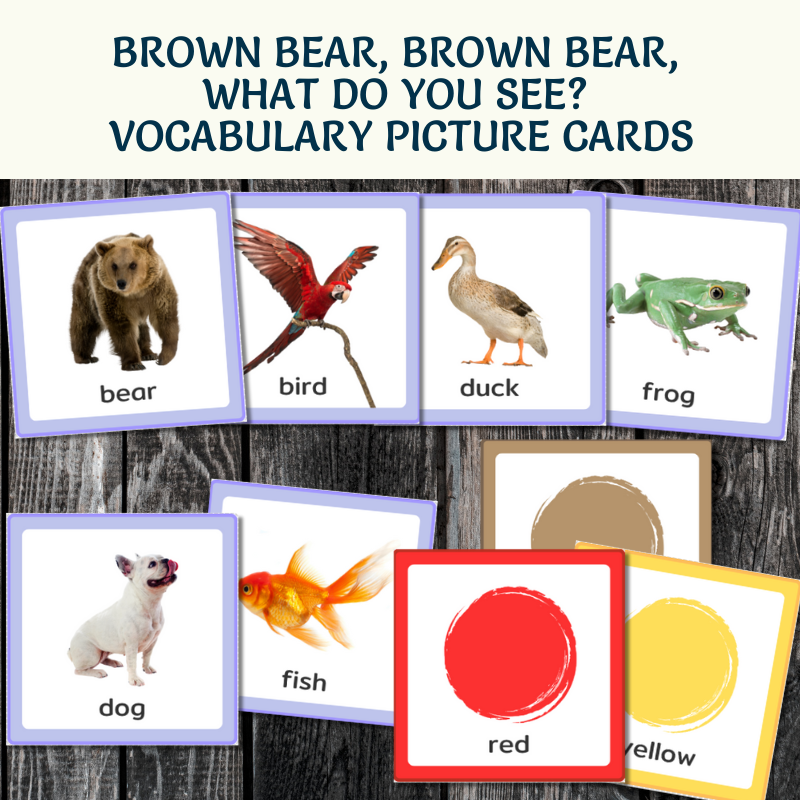
- Colour reference cards (our Brown Bear Animals and Colours Picture Cards set is particularly effective for this exercise)
The Activity:
- Set down colour reference cards on the table (if using)
- Sort the picture cards into groups based on colour, placing them next to the reference cards
- As you sort each card, explain the process: ‘This apple is red, so it goes here.’
- Name each picture and colour as you sort the cards into their respective groups
- Provide the child with a set of cards
- Instruct them to sort the cards into colour groups, creating separate piles
- Provide assistance or guidance as needed
- Once sorted, have the child name each pile and their colours
Cognitive Benefits: Colour sorting introduces children to classification – a fundamental logical thinking skill. They must identify attributes, create categories, and organise information systematically.
Progression ideas: Start with primary colours (red, blue, yellow) before introducing secondary colours. Advanced learners can sort by colour shades or multiple attributes simultaneously.
3. Sort by Size
This comparative thinking activity develops spatial reasoning and introduces mathematical concepts through hands-on exploration.
Materials needed:
- Picture cards showing items of different sizes
- Size reference cards showing ‘big’ and ‘small’ examples
The Activity:
- Set down the ‘big’ and ‘small’ reference cards
- Sort picture cards into two groups based on size: big items and small items
- Demonstrate the sorting process: ‘This card shows a big elephant, so it goes in the big pile’
- Name each item and describe its size as you sort
- Provide the child with their own set of cards
- Instruct them to sort cards into two piles: big items and small items
- Walk around providing assistance or guidance as needed
- Once sorted, have the child name and describe the items in each pile
Mathematical Foundation: Size comparison introduces fundamental mathematical concepts including measurement, comparison, and spatial relationships. These skills directly support later mathematical learning.
Extension activities: Introduce medium-sized items for three-way sorting. Use real objects alongside cards to reinforce size relationships in the physical world.
4. Memory Game (Simple Pairs)
This classic game builds working memory, attention, and strategic thinking skills through engaging gameplay.
Materials needed:
- Pairs of identical picture cards (2-3 pairs for beginners)
- Clear playing surface
The Activity:
- Introduce the concept of a memory game by showing two identical cards
- Explain that they are ‘the same’
- Lay out the picture card pairs face down in a simple pattern
- Demonstrate how to flip over two cards, trying to find a match
- If the cards match, keep them and take another turn
- If no match is found, flip the cards back over and the next player takes a turn
- Have the child turn over two cards, trying to find a matching pair
- Encourage them to remember the locations of cards they have seen
- Praise efforts and celebrate successful matches
The Level 1 Beginner Matching Set includes perfectly sized cards for small hands, with images specifically chosen for foundational memory game play.
Memory Development: Memory games strengthen working memory – the ability to hold and manipulate information mentally. This cognitive skill supports all areas of learning and development.
Adaptation tip: For very young children, start with all cards face up to focus on matching skills before adding the memory challenge.
5. What's Missing?
This attention and memory activity develops observational skills whilst building vocabulary and logical reasoning.
Materials needed:
- Sets of 3-4 related picture cards (such as different fruits or animals)
The Activity:
- Show a set of 3-4 related picture cards and ask the child to name the items
- Remove one picture card from the set whilst the child watches
- Ask the child to identify what is missing from the set
- Display a new set of 3-4 related picture cards and have the child name the items
- Remove one card when the child isn’t looking
- Ask the child to identify the missing item from the set
- Provide support by describing the missing item or giving clues if needed
- Praise efforts in identifying the missing item
Cognitive Skills Developed: This activity strengthens visual memory, attention to detail, and categorical thinking. Children must maintain mental representations of sets and notice changes.
Progression suggestions: Begin with highly different items within a category. Progress to more similar items that require closer attention to distinguish.
6. Snap!
This classic, fast-paced game combines matching skills with quick processing and excitement, perfect for developing rapid pattern recognition.
Materials needed:
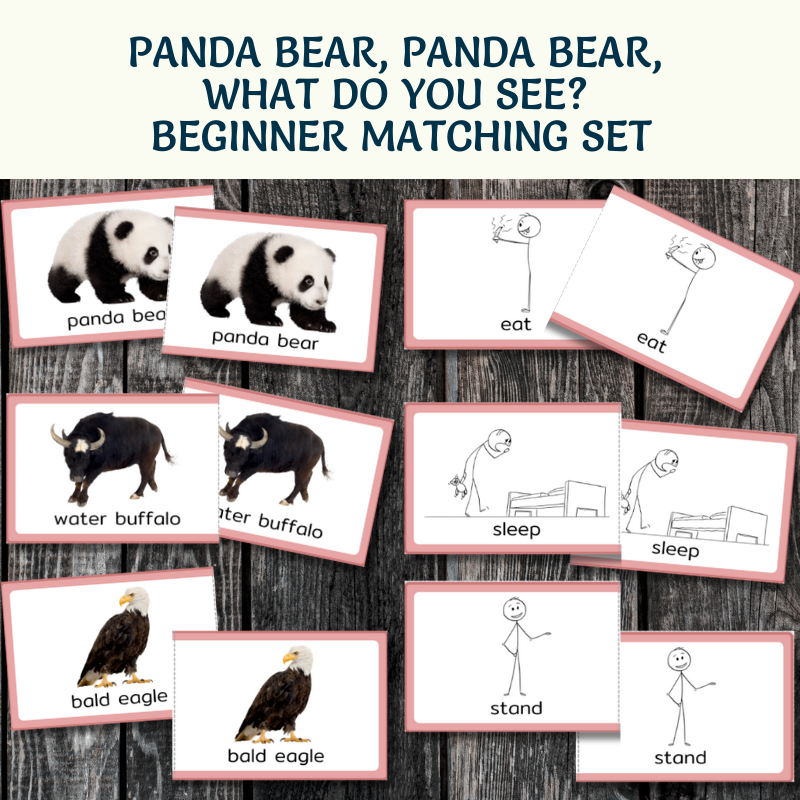
- Sets of identical picture cards (Panda Bear Beginner Matching Set works well for this purpose)
- Quick reflexes and enthusiasm!
The Activity:
- Show two identical picture cards and explain they are a ‘match’ or ‘snap’
- Demonstrate taking turns flipping over one card at a time
- When a match appears, quickly say ‘Snap!’ and collect the matching pair
- Shuffle and distribute picture card pairs between players
- Take turns flipping over one card at a time, trying to spot matches
- When a match appears, players must quickly say ‘Snap!’
- The fastest player collects the matching pair
- Continue until all cards have been matched
- Ensure the pace remains developmentally appropriate
Processing Speed Development: Snap games develop rapid visual processing and pattern recognition – skills that support reading fluency and mathematical automaticity in later learning.
Safety note: Keep the game friendly and supportive. The goal is fun and learning.
Conclusion
These six matching activities demonstrate how cognitive skills can be developed through engaging, hands-on play experiences. By incorporating visual discrimination, memory challenges, classification tasks, and strategic thinking, we create learning opportunities that build essential thinking skills whilst feeling like enjoyable games.
The key to success with matching activities lies in following the child’s developmental readiness and maintaining appropriate challenge levels. Some children will quickly master basic matching and crave more complex memory games, whilst others benefit from extended practice with foundational skills before progressing.
Foundational level materials are specifically designed to support this developmental approach to cognitive skill building. Clear imagery and thoughtfully selected matching pairs work seamlessly with activities like those shared above, creating comprehensive learning experiences that grow with the child.
References
- Clements, D. H., & Sarama, J. (2009). Learning and teaching early math: The learning trajectories approach. Routledge.
- Shams, L., & Seitz, A. R. (2008). Benefits of multisensory learning. Trends in Cognitive Sciences, 12(11), 411-417.
- Ganea, P. A., Pickard, M. B., & DeLoache, J. S. (2008). Transfer between picture books and the real world by very young children. Journal of Cognition and Development, 9(1), 46-66.
© 2026 All Rights Reserved.